

Finn
My father takes the stranger to have his brain examined just after breakfast.
This feels like an activity the entire family might benefit from, but apparently Dare is first in line.
Dad stands beside the kitchen table, explaining the plan in the same calm voice he uses when someone has died unexpectedly and he needs their family to understand what happens next.
“They’ll probably begin with a CT scan,” he says. “It’s quick, and it will rule out bleeding or swelling we couldn’t detect here. Depending on what they find, they may order an MRI.”
Dare sits across from me wearing another set of my clothes. A black sweater this time, dark jeans, and the expression of a man being told that his brain may or may not be damaged.
“Will it tell me why I can’t remember anything?”
“Possibly,” Dad says.
Which means probably not.
Dare looks toward Calla.
She is standing at the counter with both hands wrapped around a coffee mug she hasn’t lifted once. Her hair is piled on top of her head, and there are faint shadows beneath her eyes.
She looks like she didn’t sleep.
Neither did I.
“Will you come?” Dare asks her.
Calla’s fingers tighten around the mug.
Before she can answer, Dad does.
“I think it would be better if it were just the two of us.”
His tone remains gentle, but there is something firm beneath it.
Dare may remember Calla, or believe he remembers Calla, but Dad doesn’t trust that yet.
Neither do I.
Dare looks at me, and for a moment I’m back on the beach with him yesterday afternoon, walking where the tide left a dark seam across the sand.
He had tired quickly. He tried not to show it, but every few minutes his steps slowed and his attention drifted toward the ocean. It seemed more like he was waiting for it to tell him something.
“You need to turn back?” I asked him.
“No.” He took another few steps before adding, “I’m only knackered.”
I glanced at him.
He stopped.
“What?”
“Knackered?”
“Tired.”
“I know what it means.”
“Then why are you looking at me like that?”
“Because you don’t know your last name, but your British vocabulary survived intact.”
He frowned, as though the word had surprised him too.
“That answers one question,” I said.
“What question?”
“Whether you’re British.”
“You couldn’t tell?”
“I was allowing for the possibility that the head injury made you pretentious.”
He almost smiled.
I asked him questions as we walked. Nothing official. Nothing Dad or the paramedics hadn’t already asked.
Did he remember another beach?
No.
Did he know whether he could swim?
He thought so.
Did he recognize Astoria?
No.
Seattle?
He knew what Seattle was, but he didn’t know whether he’d ever been there.
He knew how far the moon was from Earth. He knew the King of Britain. He knew that octopuses had three hearts.
He did not know his birthday.
When we turned back toward the house, he asked me a question of his own.
“Do you think I can be trusted?”
I laughed because it was easier than answering.
“I don’t know you.”
Dare watched the house above us, partially hidden by the trees.
“Neither do I.”
He sounded lost, and I’d felt sorry for him.
Now he pushes his chair away from the table and stands carefully.
His balance has improved, but he still moves as though the floor might move without warning.
Calla sets down her untouched coffee.
“Let us know what they say.”
Dad reaches for the medical file he assembled last night. “We will.”
Dare keeps looking at her.
Something tightens beneath my ribs.
Until someone explains how he thinks he knows my sister, I am allowed to be vigilant.
Dad opens the door. Cold air pushes into the kitchen, carrying the smell of the sea.
Dare follows him outside. The door shuts behind them.
Calla watches through the window until Dad’s car disappears down the drive.
Upstairs, Mom is still asleep. At least, I hope she is. Calla tucked her into bed a few hours ago and told her to stay there, an instruction Mom only follows when she is too tired to argue.
For a minute, the kitchen is silent.
Rain streams down the windows. The refrigerator hums. Somewhere inside the walls, one of the old pipes knocks twice.
Calla watches the doorway.
“You okay?” I ask.
“I don’t know.”
It isn’t the answer I expect from her.
Calla always knows how she is, even when the answer is terrible. She can identify an emotion, dissect it, trace it to its earliest source, and hold it up to the light while the rest of us are still wondering why our stomach
hurts.
I get up and take the chair across from her.
“What’s wrong?”
“Nothing.”
“Compelling.”
“I mean it. Nothing is wrong.”
“But?”
She lowers her voice, although there is no one left in the room to overhear us.
“Everything feels wrong.”
The pipes knock again.
Calla glances toward the wall.
“That,” I say, “is plumbing.”
“I know.”
“And Dare has a concussion.”
“I know.”
“He nearly drowned.”
“I know.”
“His brain was recently introduced to a rock.”
“Are you finished?”
“I have several more.”
Despite herself, the corner of her mouth lifts.
It disappears quickly.
“There’s something strange about him,” she says.
“Dare?”
“No, Dad. Yes, Dare.”
“He has amnesia.”
“I know.”
“He nearly drowned.”
“You already used that one.”
“It remains relevant.”
“Finn.”
“What?”
“The way he keeps looking at me like he knows me is unnerving."
“That’s why Dad is taking him to the hospital.”
“A brain scan isn’t going to tell us whether he knows me.”
“No, but we already know he doesn't. It might tell us whether he has a tumor pressing on the part of his brain responsible for mistaking hostile photographers for old friends.”
“I’m not hostile.”
“You photographed him unconscious.”
“For documentation.”
She reaches for my coffee.
I move it out of range.
“You have your own.”
“It’s cold.”
“That sounds like a consequence.”
She sinks into the chair across from me.
“I decided Mom’s dream was a coincidence.”
“What dream?”
Calla looks toward the ceiling, as though she can see through it to Mom’s bedroom.
“She had her car crash dream again.”
The muscles across my shoulders tighten.
“And this time, she heard a Smiths song playing.”
“So?”
“That song was playing in our car.”
I stare at her. “What?”
“When the semi almost hit us yesterday, that song was playing. There is a light that never goes out.”
I think back to the highway. I don’t remember the song.
But Calla would.
“You play the Smiths constantly,” she continues. “So of course it showed up in a nightmare.”
“Exactly.”
“I know.”
She doesn’t sound convinced.
I study her face.
Calla rubs her hands over her arms.
“It still feels creepy.”
There is no logical response to that.
Because it does.
She feels it too.
The words pass through my mind as clearly as if someone has leaned close and whispered them.
I go still.
Calla is saying something else.
I don’t hear her.
She feels it too.
No.
It is my own thought. It has to be. She just told me she feels uneasy, and my brain converted that information
into a sentence.
Brains do that.
They make thoughts.
It is arguably their defining feature.
“Finn?”
I look at her.
“What?”
“You stopped listening.”
“I was thinking.”
“That must have been disorienting.”
“Deeply.”
She watches me for another second.
Then she says, “And the beer cap could have been carried by a bird.”
I stop.
“What beer cap?”
Calla looks at me for half a second too long.
Then she stands.
“Come upstairs.”

Her bedroom smells faintly of rain.
The window is closed and locked.
I notice because Calla almost never locks it. She likes cold air, even when the cold air is trying to kill her. In Seattle, she slept with her window cracked through most of the winter and then complained every morning when her nose was runny.
She crosses to the nightstand and picks up two bottle caps.
Both are red and white.
Rainier.
She lays them in my palm.
One is the cap Edgar left on the fire escape in Seattle. I recognize the bent edge and the scratch running through the red R. Calla treated it like treasure because Edgar had brought it to her.
The second cap is nearly identical.
Not just the brand.
The bend.
The scratch.
I turn them beneath the light.
“Where did you get this?”
“It was on my windowsill last night.”
“When?”
“I found it after I woke up. The window had been open while I was sleeping.”
The back of my neck prickles.
I ignore it.
The caps are not exactly the same. The scratches differ if I angle them toward the window. One edge is bent a little farther than the other.
Similar objects, but not identical.
That should help.
It doesn’t.
“Why didn’t you tell me?”
“I was going to.”
“When?”
“Now, apparently.”
“And you locked your window after finding this?”
“I didn’t think someone climbed onto the roof and left me a beer cap.”
“But you locked the window.”
Calla looks away.
“I told you. I feel uneasy.”
The admission changes something in the room.
For as long as I can remember, Calla has been the one who feels everything first. I wait for evidence. She senses the storm; I check the forecast.
Usually, one of us is wrong.
Lately, neither of us seems to be.
Calla points toward the window.
“There’s a lower section of roof beneath this side of the house. If someone wanted to reach the window, they might be able to climb up from the porch.”
“Someone with a ladder.”
“Or a death wish.”
I unlock the window.
Calla frowns. “What are you doing?”
“Investigating.”
“You’re wearing socks.”
I look down.
She’s right.
This briefly damages my authority.
I remove them, toss them onto her bed, and push the window open.
Rain-cooled air moves through the room.
“Finn.”
“I’m not going far.”
“The roof is wet.”
“Thank you, Calla. Without your medical expertise, I might have mistaken it for fire.”
I brace one hand against the frame and step onto the shingles.
The lower roof slopes gradually beneath the window, broad enough to walk on without immediately plunging to my death. The rain has slowed to mist, but everything is slick. I keep one hand against the outside wall until my footing feels secure.
Below me, the side lawn disappears into a stand of spruce and hemlock. The porch roof extends around the corner, but there is no trellis and no drainpipe sturdy enough to support a person. The closest branch is at least eight feet from the house.
No one climbed up here without equipment.
I crouch near the window.
The gutter holds leaves, pine needles, and the decomposing body of something I can’t identify. There are no other bottle caps. No footprints. No scratches around the sill.
Nothing.
“What do you see?” Calla calls.
“Evidence that Dad should clean the gutters.”
I move a little farther down the slope.
A crow sits on the fence at the edge of the lawn.
Its feathers shine blue-black beneath the gray sky. It watches me with the still, direct attention particular to crows, as if it knows exactly what I am doing and finds my methods disappointing.
“Hello,” I say.
The crow tips its head. It lifts one wing to resettle its feathers.
A flash of white appears beneath the left one.
Small.
Barely more than a mark.
My breath catches.
The bird folds its wing, and the white vanishes.
I look back at the window.
“Calla.”
Her head appears. “What?”
“Did Wollsy have a white spot under her wing?”
Her expression changes.
“Yes.”
“Which one?”
“The left.”
I look toward the fence.
The crow is still there.
“Why?”
“That crow has one.”
Calla leans farther through the window.
“Where?”
“On the fence.”
The crow turns its head toward her.
“Can you see the white?”
“Not with its wings folded.”
Rain beads in my hair and runs cold down the back of my neck.
The crow gives us nothing.
“It’s not Wollsy,” Calla says.
“No.”
“She can’t be here.”
“No.”
“She wouldn’t even know where we went.”
“No.”
Calla narrows her eyes. “You don’t believe any of those things.”
“I believe all of them.”
“You sound like you’re trying to convince yourself.”
“I’m trying to convince you.”
“You’re doing a terrible job.”
The crow hops once along the fence.
Calla pulls back from the window. “I have peanuts downstairs.”
“Of course you do.”
“Stay there.”
Before I can object, she disappears.
I turn back toward the lawn.
The fence is empty.
I scan the trees, but the crow is gone.
Another coincidence.
A bird with an unusual feather. A bottle cap dropped on a windowsill. A song appearing in someone’s dream.
Nothing supernatural.
Nothing impossible.
I straighten carefully.
From here, I can see the ocean between the trees. Gray water. Gray sky. No clear line between them.
The edge of the roof is five feet ahead.
I look down.
Jump.
My entire body jerks, as the word crosses my mind.. My right foot slips.
For one sickening second, the shingles move beneath me and the world tilts toward the ground.
I catch the window ledge with one hand.
Pain shoots through my shoulder.
I freeze, breathing hard.
The word did not come from below.
It did not come from the woods.
It did not come through my ears at all.
It came from inside my own head.
Do it.
My fingers tighten around the ledge.
Do it.
I move.
Not toward the edge.
Toward the window.
I keep one hand against the wall and take each step slowly, refusing to look down again. My pulse pounds against my throat. The wet shingles scrape beneath my bare feet.
Do it. Do it. Do it.
“No,” I say.
The voice stops.
I reach the window, grip the frame, and climb through so quickly that my knee strikes the sill.
I land badly on Calla’s floor.
Then I slam the window closed. The lock resists my hand because I’m shaking.
I force it into place.
For several seconds, I stand there with both palms pressed against the glass.
The room behind me is empty. My reflection stares back from the window.
Pale face. Wet hair. Wide eyes.
I look like someone who has just been frightened.
I am not frightened.
I slipped.
That is all.
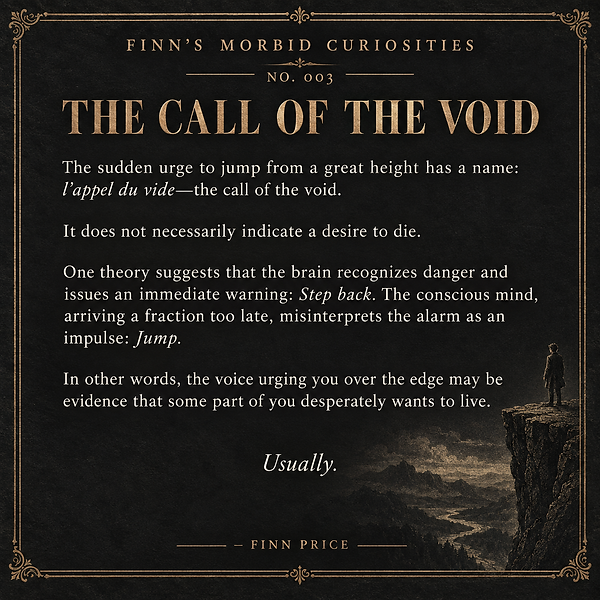
People experience intrusive thoughts near heights. It is common enough to have a name: the call of the void. The brain recognizes danger and momentarily imagines it. A neurological misfire. An evolutionary warning system.
Jump.
Do it.
Do it.
My brain generated the words because I was standing near an edge.
It did not want me to obey them.
The bedroom door opens.
Calla enters carrying a bag of peanuts.
She stops.
“What happened?”
“Nothing.”
“You’re bleeding.”
I look down.
A thin red line runs along my forearm where I scraped it against the window frame.
“I slipped.”
Her face drains.
“I told you the roof was wet.”
“Yes, and you’ve been very vindicated.”
She drops the peanuts onto the bed and crosses to me.
“Let me see.”
“It’s a scratch.”
“Did you almost fall?”
“No.”
The answer comes too quickly.
Calla looks at me.
For one terrible second, I think she knows.
“I’m fine,” I say.
Her gaze moves over my face.
Then she takes my arm and examines the scrape.
“You don’t look fine.”
“I’m wet, bleeding, and missing my socks. No one looks their best under those circumstances.”
She doesn’t laugh.
Outside, the fence remains empty.

Mack calls while I am changing my shirt.
Her name appears on my screen, and something in my chest loosens before I answer.
I close the door and sit on the edge of my bed.
“Hello?”
“Finn Price,” she says. “You’re alive.”
“Debatable.”
“I texted you forty-three minutes ago.”
“I was busy.”
“With what?”
“Roof inspection.”
There is a pause.
“Is that a euphemism?”
“Not a good one.”
“Your euphemisms are usually much more upsetting.”
I smile despite myself.
Mack has that effect. The world can be ending, but if she is present, she will find something inappropriate to say about it.
It may be the foundation of our relationship.
Whatever our relationship is.
We have deliberately avoided defining it for almost a year, which requires more commitment than defining it probably would.
“What were you doing on the roof?” she asks.
“Inspecting it.”
“Ah. Thank God you clarified.”
“Calla found something on her windowsill.”
“What?”
“A beer cap.”
“Scandalous.”
“There are two.”
“Finn, should I sit down?”
“One was from Seattle.”
The humor leaves her voice.
“The one Edgar gave her?”
“Yes.”
“And the other?”
“Here.”
“That’s weird.”
“It’s Rainier. There are probably ten thousand of them within a fifty-mile radius.”
“Did the other ten thousand climb onto Calla’s windowsill?”
“A bird could have dropped it.”
Mack is quiet.
“What?” I ask.
“You sound strange.”
“I always sound strange.”
“No. Usually you sound strange on purpose.”
For a moment, neither of us says anything.
Rain taps against my window.
I look at the lock.
“What happened?” she asks.
“Nothing happened.”
“That wasn’t my question.”
“It was literally your question.”
“Finn.”
“Mack.”
“Don’t do that.”
“Do what?”
“Use my name like it’s an argument.”
“It’s an excellent name. Very persuasive.”
She exhales.
I can picture her in her apartment, probably sitting cross-legged on the sofa with a half-finished mug of tea growing cold on the table. Her windows will be open despite the Seattle weather, and there will be a record playing too softly for me to hear through the phone.
“I found one of your shirts under my bed,” she says.
“Keep it.”
“I was going to burn it.”
“That’s practically domestic.”
“Don’t ruin it.”
There it is.
The thing between us we only touch while pretending not to.
I lie back on the bed and cover my eyes with one hand.
“How’s Cheeto?” she asks.
“Thriving. He’s claimed Dad’s office chair and attacked a condolence arrangement this morning.”
“I miss him.”
“He probably misses you.”
“Probably?”
“He’s emotionally withholding.”
“He gets that from you.”
“I’ve never knocked a vase of funeral lilies onto the floor.”
“You would if it prevented you from discussing your feelings.”
This is fair, so I ignore it.
“What about you?” she asks.
“What about me?”
“I’ve decided I miss you.”
The words are light, almost careless.
Mack is skilled at making honesty sound accidental.
“I miss you too.”
“I know.”
“You seem confident.”
“You answered on the second ring.”
“I contain multitudes.”
She lets the silence settle.
With Mack, silence is rarely empty. It stretches between us, familiar and comfortable, carrying the things neither of us intends to say.
“Tell me what’s happening,” she says.
So I do.
Most of it.
I tell her Dare remembered his first name. I tell her he thinks he knows Calla but cannot remember how. I tell her Dad took him for a brain scan.
I tell her about the crow with the white mark beneath its wing.
I do not tell her what happened on the roof.
When I finish, Mack is quiet again.
“You think it was Wollsy.”
“No.”
“You’re a terrible liar.”
“I’m an excellent liar. You’re irritatingly observant.”
“Wollsy can’t be in Oregon.”
“I know.”
“Unless she got on a bus.”
“She doesn’t have pockets for the fare.”
“Maybe she has a crow Venmo.”
I laugh.
The sound surprises me.
Mack hears it.
“There you are,” she says softly.
Something inside me tightens.
“I’m here.”
“What aren’t you telling me?”
Nothing.
The answer rises immediately.
Too immediately.
“I hit my head on Calla’s window.”
“What?”
“Minor roof-inspection injury.”
“Jesus Christ.”
“It’s a scratch.”
“I leave you unsupervised for three days, and you become a roofer.”
“I contain vocational possibilities too.”
She tells me I’m an idiot.
I tell her I’ve missed her tenderness.
By the time we hang up, my breathing has returned to normal.
The room feels like my room again.
My mind feels like mine.

Dad and Dare return shortly before dinner.
Mom’s bedroom remains quiet upstairs. Calla appears from the back of the house, and the two of us gather in the hall like a family waiting for examination results.
Dare looks exhausted but otherwise unchanged.
“The CT was clear,” Dad says.
Calla exhales.
“No bleeding,” Dad continues. “No swelling. No mass. Nothing that requires immediate intervention.”
“But?” I ask.
“But he does have a concussion. They believe the amnesia is related to the trauma, although its extent is unusual.”
“How unusual?” Calla asks.
Dare answers. “I know what everything is except me.”
His voice is flat.
Dad rests a hand briefly against his shoulder.
“His general memory is intact. Language, factual knowledge, ordinary skills. It’s his autobiographical memory that’s impaired.”
“Will it come back?” Calla asks.
“The neurologist thinks it may. Dare remembering his name is encouraging. We’ll schedule an MRI and follow-up evaluation if there isn’t continued improvement.”
Dare looks at Calla again.
She gives him a small smile.
“You remembered one thing,” she says. “That means you can remember another.”
Maybe she believes it. Maybe he does too.
I look at Dare and think about the beach.
Do you trust me?
I don’t know you.
The doctors examined Dare’s brain and found nothing alarming.
Mine told me to jump off a roof.
I say nothing.

The rain stops after dinner.
I wait until everyone has gone upstairs before I step outside.
I tell myself I need air.
This is not entirely a lie.
The night smells have been washed away. Water drips from the trees and gathers in the gravel beneath the eaves. Beyond the lawn, the ocean moves against the shore.
I walk around the side of the house.
The fence is empty.
I should be relieved.
Instead, I stop beneath Calla’s window and look up at the dark square of glass.
From the ground, the roof appears steeper than it did from above.
My forearm stings beneath the bandage Calla insisted on applying.
Jump.
The word returns in my memory.
Only my memory.
I put both hands into my pockets and turn toward the house.
A branch moves behind me.
I stop.
The crow is perched on the fence.
It watches me.
Its feathers absorb the darkness until only the shine of its eyes separates it from the trees.
My heart begins to beat faster.
“Wollsy?”
The crow tilts its head.
I feel ridiculous.
Wollsy is in Seattle. Probably sitting on the fire escape waiting for someone who no longer lives there to bring her peanuts. This is another crow. Another bird with an unusual feather. Another coincidence I’ve mistaken for a pattern because my brain is tired and frightened and trying to impose order on unrelated things.
I take one step toward the house.
Behind me, something makes a rough, broken sound.
A scrape of air. Almost a word.
I turn.
The crow opens its beak.
“Finn.”
My name emerges warped and hollow, shaped by something that should not be able to shape it.
I cannot move.
The crow stares at me.
“Say it again,” I whisper.
It doesn’t.
I wait.
Water drips from the trees. The ocean strikes the shore.
Nothing else moves.
Maybe it didn’t speak.
Maybe its call only resembled my name.
Maybe the sound never came from the crow at all.
It lifts its wings.
A small white mark flashes beneath the left one.
Then it flies into the darkness.


From the Estate
Recovered materials, private records, and curiosities from the episode
Recovered Artifacts
Objects recovered and documented in this Storyworld
(Click an artifact to examine)


